Hi there!
So you’ve decided you want to explore cancer biology a little deeper and learn more about all the interesting subfields it has. This guide will help you dip your toes into cancer biology research by explaining how to read review papers. By practicing this skill, you’ll soon be able to read research papers and understand them (with a lot of work).
Table of Contents
- What Are Review Papers
- How to Find Review Papers
- Sections of a Review Paper
- How to Read a Review Paper
- Conclusion
- Sources
What Are Review Papers?
Review papers are collections of research papers that aim to summarize a field (kind of like SparkNotes). Authors collect all sorts of research papers across a field, take detailed notes, and then use them to discuss what’s happening in the field. In this guide, we’ll specifically be looking at an important review paper focused on what defines a cancer cell.
Tips for Reading Review Papers
As you begin to read the review paper, don’t worry. It will look (very) intimidating at first, but as you work your way through, it will slowly make sense. Some tips I have are:
- Set goals for yourself
- You don’t have to finish reading a research paper in one sitting ( and you shouldn’t). Instead, aim for reading 1-2 pages per day when you first start to really understand the content and not rush yourself.
- Write down definitions in a notebook or Google Doc
- Doing so allows you to apply what you just learned via active recall and make a definition that uniquely makes sense to you. You can also use it later to look up the meaning of a word if you forgot it.
- Take notes while reading a paper.
- Sometimes, you can read a paper and have no idea what it talked about at the end, because it’s so easy to skim through and pretend to remember what the paper described. A rule of thumb is that after reading a paragraph, briefly summarize it in your notes.
- Highlight a lot
- Most review papers weren’t made for optimal readability, but instead for the efficient compartmentalization of knowledge. As a result, papers tend to be filled with dense paragraphs, which can be painful to read. Highlighting as you read allows you to pay attention and make note of important concepts. Highlighting on either a physical copy of the review paper or an online version works.
Don’t worry if a paper is swimming in unfamiliar terms. This is completely normal! If you get through and understand a review paper, you’ll have the basic foundation to tackle just about any other paper in the field. The hardest part is just learning and keeping track of all the different jargon used.
How to Find Review Papers
The most important part of reading review papers is learning where to find them. In this guide, we’ll be focusing on how to find free review papers, as databases are often restricted to schools or organizations. Google Scholar is a good resource to search for papers.
Google Scholar is a service provided by Google, for free, that finds almost all the research papers in a subfield or field. To use it, search for the specific field you want to explore. In this example, we will be using cancer biology.

When you do search this up, you’ll get something that looks like this:
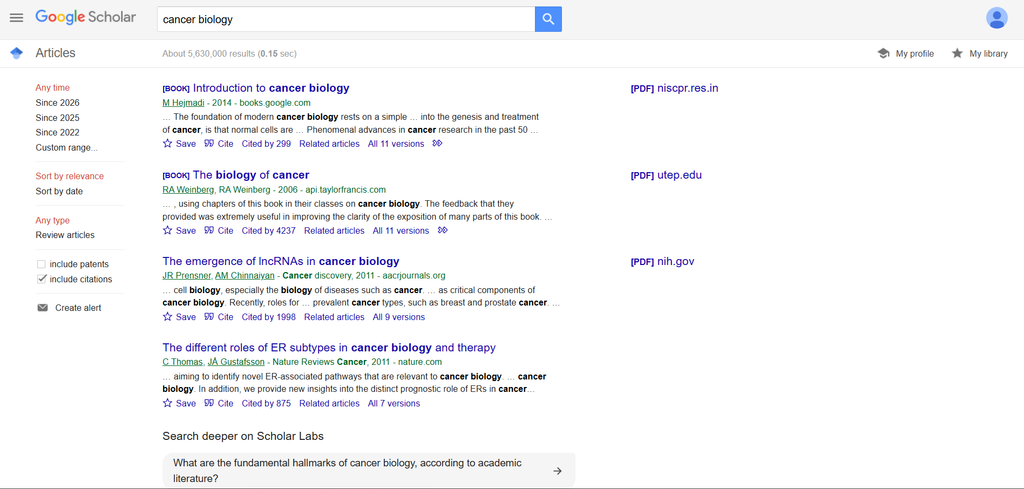
If you want articles from a certain period, use the sort by date button on the left-hand side. If you specifically want a review paper, press the review articles text under Any Type on the left-hand side.
Let’s click on the link called “The different roles of ER subtypes in cancer biology and therapy”.
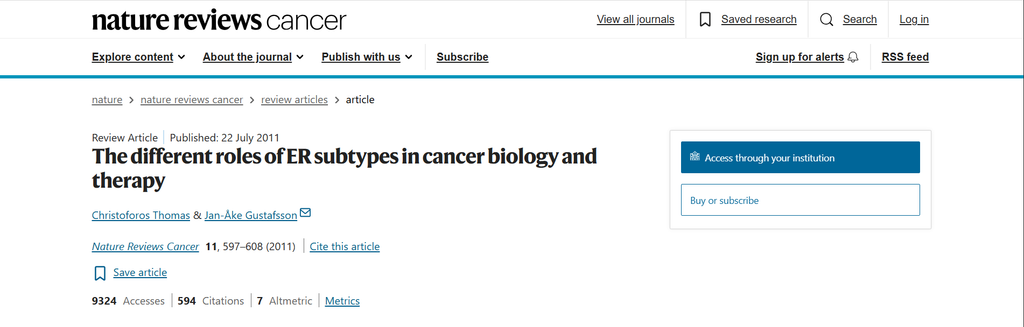
If you look on the right-hand side, you’ll see that this paper has been paywalled ( it has an access through your institution button). Unfortunately, since we don’t have access to a database, we cannot access this article. There are still lots of wonderful, free articles to explore, though.
Let’s go back and click on the paper titled “The emergence of incRNAs in cancer biology”.
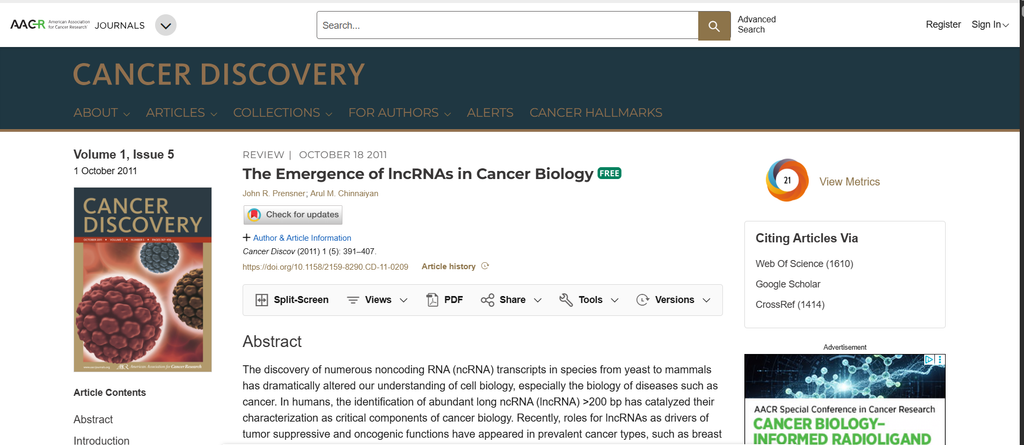
This review paper is free ( it has a free symbol next to the title). To download it, click the PDF button below the title in the grey box. You’ve got your first review paper!
Sections of a Review Paper
Here are the main parts of a review paper:
- The title
- This gives you a general idea about what the research paper is about
- A small summary
- There is usually a small summary under the title that gives a brief, simple explanation about what the paper is about. I would recommend searching up the terms here and learning them in order to understand the rest of the paper better.
- The introduction
- This usually frames the field and why the review paper is needed. It might talk about past discoveries, future endeavors, and what specifically the field is about. It’ll also mention what topics the review paper will be covering.
- The body paragraphs
- These are the meat of the paper. They describe the patterns found in all the research papers cited, and build a comprehensive view of the specific field or subfield. They are usually accompanied by diagrams and graphs to aid in understanding.
- Diagrams
- These are drawings illustrating different pathways or concepts in the paper. Despite their intentions, they can sometimes be pretty hard to figure out. I would recommend deciphering these after finishing reading the whole paper. Usually the descriptions underneath can be a good starting point for understanding them.
- Graphs
- These are diagrams explaining how a certain claim is accurate, usually using data and statistical tools like box and whisker plots. These are hard to decipher, but are rarely added to review papers.
- Conclusion
- The conclusion is a general summary of what was reviewed in the paper. I would recommend reading this last to check whether you understood the main points of the review paper.
- References
- These are the research papers that the review paper cited. If you want to go deeper into a field, these are a great place to start from.
How to Read a Review Paper
Welcome to reading review papers! The one that we’ll be going over is essential to the cancer biology field: “The Hallmarks of Cancer” by Douglas Hanahan and Robert A. Weinberg.
Most review papers you read will be a little harder to read than this one because they cover an entire field, hence lots of jargon. This paper is meant to introduce beginners to cancer biology in general, so it doesn’t assume too much prior knowledge.
As you click on it, it might seem like a lot. As mentioned before, these papers are made for the efficient compartmentalization of knowledge, which means that dense passages and tiny font are the norm. Don’t panic; they’re not as bad as they look.
First, start by skimming the paper. Here, you just need to note what the subtitles say and get a general idea about the diagrams. After this step, start reading the paper.
Let’s start with the introduction.

I like to highlight as I read through a section so I can understand what’s going on (it’s pretty hard to read a block of text without annotating it). General highlighting as I read has been marked with green. I also recommend highlighting terms or concepts that are unfamiliar with a different color when reading through a paragraph.
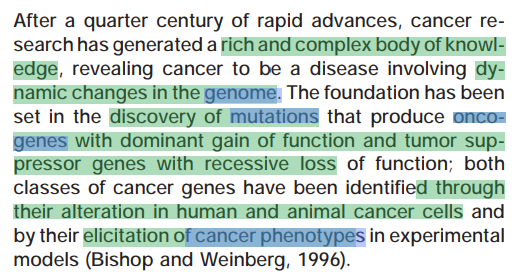
The next step is to look up what the unfamiliar terms (highlighted blue) mean. Let’s use oncogenes as an example:
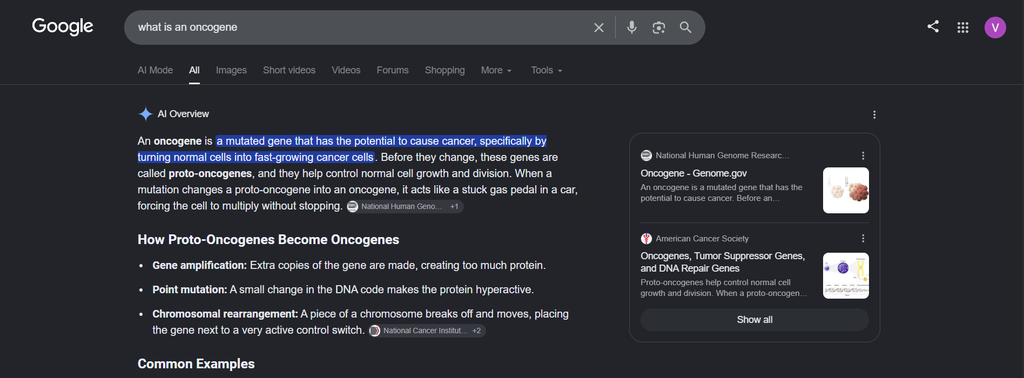
The Gemini summary is a good introduction to what an oncogene is. After reading it, I would then scroll down and read through the other websites listed. Make sure to take notes on the unfamiliar terms!
After you’ve looked up what all the unfamiliar terms mean and taken notes on them, reread the paragraph and connect all that knowledge together. At the end, summarize the paragraph into your own words and then write it down in your notes.
Down below are some common questions, and my solutions to them:
What if I don’t understand what an entire sentence means?
Let’s use this sentence as an example:
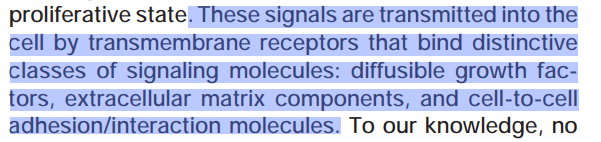
For complex sentences, I would recommend searching up the exact sentence + “what does this mean” into Google. The Gemini summary is good for getting a basic understanding of the sentence. After that, make sure to individually search up the terms you don’t understand and learn about them to gain a deeper understanding.
How do I understand diagrams?
Let’s use this diagram from the paper as an example:
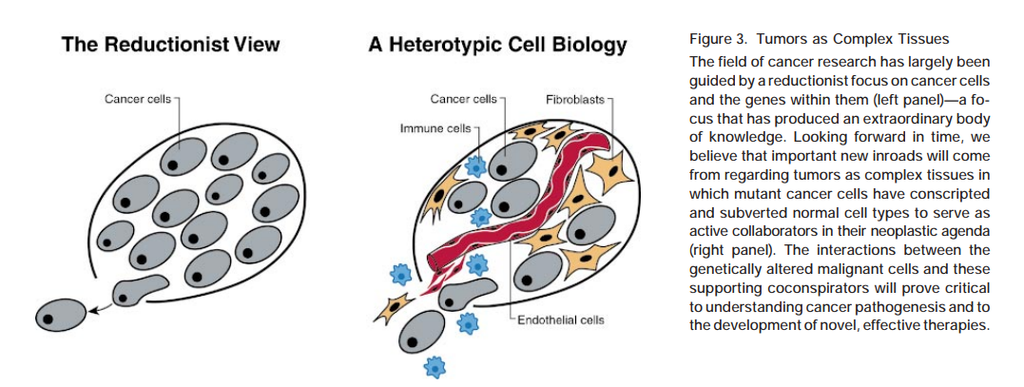
The first thing to look at in diagrams is the blurb of text next to the image. Reading this can help provide a good idea about what the diagram is trying to explain. Of course, highlighting this text and looking up unfamiliar terms applies here. After reading, you can then look at the image, which aims to visualize the information you just read.
What order should I read research papers in?
I would recommend going chronologically from introduction to conclusion. At the end, make sure to visit the diagrams and try to make sense of them.
Conclusion
You did it! You’ve learned the parts of a review paper and how to read one. Your next challenge is to finish the review paper mentioned here.
As you read more and more review papers, they’ll become easier to understand ( and you’ll spend less time reading them).
Don’t worry if it takes you a long time to understand your first one. This paper aims to set up the foundations of cancer biology, so spending more time to really internalize it is important.
Hopefully when you finish this review paper, you’re inspired to keep digging deeper.
If you learned anything, make sure to send us a message on our Instagram (@whencellsresist). We love hearing back from our readers!
All original insights and illustrations are our own. This content is not intended as medical advice.
Sources:
https://pubmed.ncbi.nlm.nih.gov/21779010