Written by Staff Writer Arsheen Kaur
What if cancer cells could borrow different abilities from cells in your immune system?
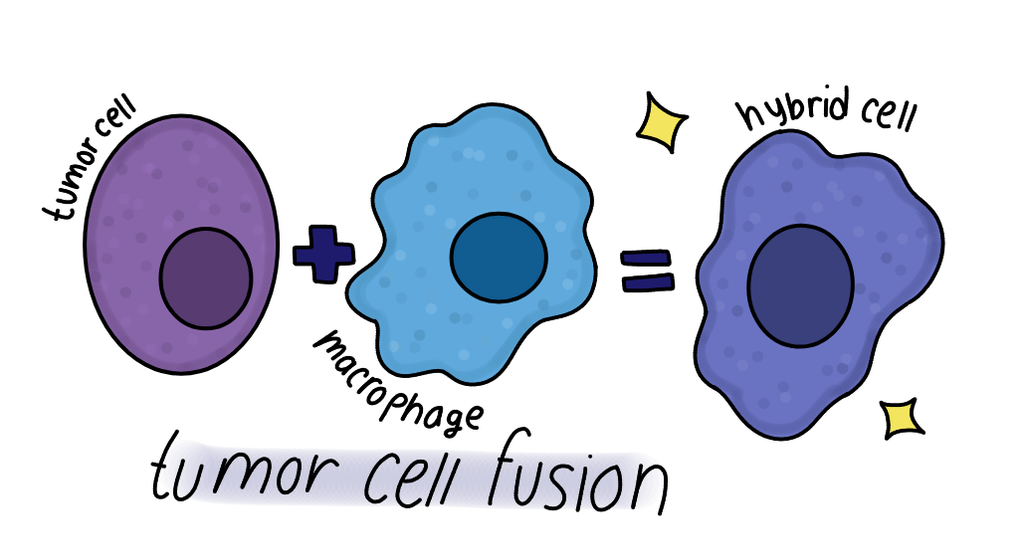
Scientists are investigating the possibility that two different cells can sometimes fuse into one hybrid cell, allowing cancer cells new ways to spread.
Tumor cell fusion is a theory that has been around for over a century, overlooked for decades, and is currently seeing a resurgence due to advances in molecular analysis, imaging, and single-cell sequencing, where scientists can see and analyze the genetics of individual cells, allowing researchers to detect the cells.
What is Tumor Cell Fusion
A German pathologist named Otto Aichel proposed a century ago that cancer cell fusion can help tumors initially metastasize, or spread from the original site to other parts of the body.
His hypothesis was that in cancer cell fusion, a cancer cell could physically fuse with another cell (usually an immune cell), allowing the resulting hybrid cell to inherit traits from both cells. This would allow it to be better at metastasizing.
For most of the 20th century, this theory declined in the shadow of more accepted explanations of how tumor metastasis could begin, like the epithelial-mesenchymal transition, or the cancer stem cell model.
It has resurfaced in the last 15 years, though, due to increased molecular tools being able to detect these hybrid cells.
What Actually Happens During Fusion
The most studied kind of cancer cell fusion involves macrophages. These cells are white blood cells that find and then engulf pathogens, or foreign things.
Fusion can produce a binucleate heterokaryon from the nuclei of each of the cells. A binucleated heterokaryon is a cell containing 2 different nuclei. This cell later can undergo karyogamy (when the nuclei fuse), resulting in a hybrid macrophage/ cancer cell that contains the genetics and physical traits from both cells. Each fusion event is a little different, though.
One of the more specific proposed mechanisms of cancer cell fusion recently found in the lab involves a receptor interacting with a molecule. A lipid called phosphatidylserine normally faces the inside of the cell membrane, towards the inside of the cell. However, it is flipped to the outside under stress (like radiation exposure).
When it flips, it acts as a “fuse with me” signal that another cell’s CD36 receptor can recognize and bind to.
This same study found that this fusion could be induced by ionizing radiation, a form of radiation that can damage DNA and is also used in cancer treatment.
What New Abilities Could Hybrid Cells Gain
Several specific advantages involving hybrid cells have been identified. One advantage is the ability to combine “superpowers”. Cancer cell fusion can lead to cellular reprogramming (where the cell changes how its genes are read), allowing new tumor cell subsets to be able to chemotactically migrate.
This means that the hybrid cell has the macrophages’ ability to migrate by following chemical signals, and the cancer cell’s ability to undergo uncontrolled cell division.
Future Applications of Hybrid Cells
Researchers are investigating specifically how hybrid cells can cause metastasis, and how we can use them to detect cancer.
Researchers are currently investigating using hybrid cells as a liquid biomarker ( measurable substances like proteins found in body fluids) that would be detectable in a blood draw, complementing the information given by a tissue biopsy, or when a sample of cells is removed from the body. The reasoning behind this is that if hybrid cells are correlated with metastatic risk, finding and counting them in blood samples could be an early warning sign.
A very recent colorectal cancer study also found that hybrid cells can gain heightened transcriptional plasticity. This is when a cell is able to change its gene expression, or what proteins it makes, quickly, allowing cancerous cells to metastasize and resist treatment.
What Scientists Still Don’t Know
Despite the recent rise, this is still being discussed as a hypothesis rather than an accepted fact. The mechanisms are becoming increasingly understood, but how common fusion events are in human tumors overall compared to other mechanisms of metastasis (like the EMT or cancer stem cells) is still being worked out.
Conclusion
Tumor cell fusion is one of the many other fascinating ways that cancers can metastasize and survive. Researchers are still trying to figure out the specific mechanisms behind these cells and how often they occur, as well as how we can use them for cancer detection and treatment.
If you learned anything, make sure to send us a message on our Instagram (@whencellsresist). We love hearing back from our readers!
All original insights and illustrations are our own. This content is not intended as medical advice.
Sources
https://www.spandidos-publications.com/or/46/1/145
https://www.ncbi.nlm.nih.gov/pmc/articles/PMC7084898/
https://www.ncbi.nlm.nih.gov/pmc/articles/PMC11698428/
https://www.ncbi.nlm.nih.gov/pmc/articles/PMC5037852/
https://pmc.ncbi.nlm.nih.gov/articles/PMC10923029/
https://aacrjournals.org/cancerres/article-pdf/doi/10.1158/0008-5472.CAN-25-0261/3708996/can-25-0261.pdf
https://www.biorxiv.org/content/10.64898/2026.04.12.717781.full.pdf
https://www.ncbi.nlm.nih.gov/pmc/articles/PMC11832717/