Every organism has a blueprint, known as DNA. This is a set of instructions that tells cells how to function, grow, and replicate. However, what happens when this blueprint gets edited? These edits, called mutations, can be neutral, beneficial, or even deadly. In this article, we will explore what mutations are, how they happen, the different types, and why they matter, especially for cancer.
What Are Mutations
Mutations are changes in an organism’s DNA. This is like the instruction manual that tells cells how to make specific proteins. Those proteins help carry out the functions of the cell, so the DNA really controls the activities of the cell.
DNA is made of 4 types of nucleotide bases: A,T,C, and G on a sugar phosphate backbone. It is coiled around proteins called histones to form chromosomes in the cell that are stored in the nucleus.
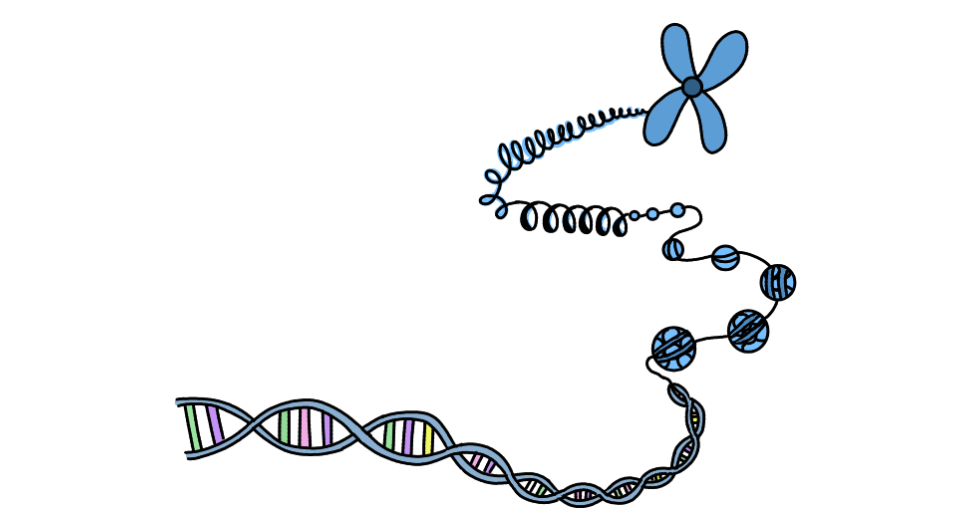
Within the DNA, genes serve as the code for specific proteins. Groups of 3 nucleotides in the genes that code for a specific amino acid, the building blocks of proteins, are called codons. To learn more about DNA, here is a previous blog post.
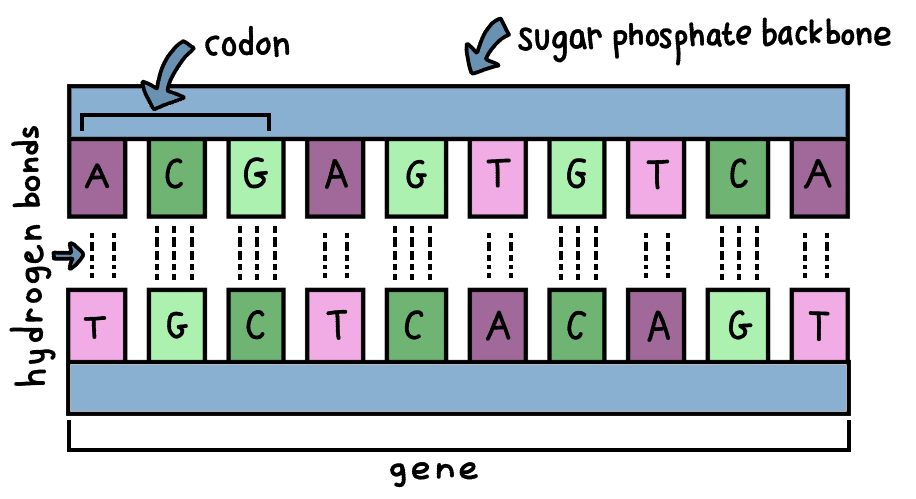
Mutations in a codon can cause a different amino acid to be produced, and thus a protein with a completely different function or no function at all to be made.
DNA Mutations: Germ-Line vs Somatic
Mutations come in many different forms, but in this article, we will focus on DNA mutations. These can be divided into 2 categories:
- Germ-line mutations
- These happen in a germ cell ( like a sperm or egg cell ).
- Because they occur in a reproductive cell, these mutations can be passed down to offspring.
- Somatic mutations
- These occur in a non-reproductive cell, also called a somatic cell.
- These mutations cannot be inherited.
Mutations can be harmful, beneficial, or neutral. Most mutations do not have a noticeable effect on the cell. This can be because the mutation doesn’t occur in a protein-coding area of the DNA, or it codes for the same amino acid as before. Some, however, can be advantageous. Lactose tolerance, for example, is caused by a nucleotide change ( substitution ) in the MCM6 gene, extending lactase production past childhood.
How Do Mutations Occur
Mutations arise through 2 main pathways: errors during DNA replication and exposure to mutagens.
DNA replication errors occur when replisomes, a complex made of many different proteins , encounter an obstacle during replication and stall. Errors during replication can usually be fixed, though.
There are 2 types of ways that cells repair mutations during and after DNA replication:
- Proofreading
- Mismatch repair
During proofreading, DNA polymerase ( the type varies between organisms ) reads the nucleotide base that has just been added to ensure it is the right nucleotide. If an incorrect base has been added, then the enzyme will snip it out via its exonuclease portion and replace it with the correct one.
Mismatch repair happens shortly after DNA replication. A mismatch means that bases are not aligned with their traditional pairings, such as A to T and C to G. A complex of DNA repair proteins finds where the mismatch is, cuts the DNA at the mismatch, replaces it with the right nucleotides, and then seals it. Cells also have DNA damage repair mechanisms that allow them to repair damaged DNA in general.
If errors accumulate faster than they can be repaired, then the cell either stops dividing or destroys itself in a process called apoptosis.
Mutations can also be caused by mutagens. Mutagens are any chemical or physical agents that can damage DNA and increase mutation chances. Carcinogens, agents that cause cancer, on the other hand, can also cause cancer through both mutations and other mechanisms.
What Are the Types of Mutations
Mutations can affect 1 nucleotide (point mutations) or many nucleotides. Both of these can still cause damage to the DNA. These mutations happen the most often during DNA replication. Here are the different types of mutations:
- Substitution: One nucleotide is swapped for another. This can cause:
- Missense mutation: Codon codes for a different amino acid.
- Silent mutation: Codon still codes for the same amino acid.
- Nonsense mutation: Codon becomes a stop signal, halting protein production.
- Insertion: One or more nucleotides are added to DNA.
- Deletion: One or more nucleotides are removed from DNA.
Insertion and deletion mutations can cause either frameshift or in-frame mutations to occur. Frameshift mutations are the deletion of nucleotides in a number other than 3, causing the frame to be shifted. In-frame mutations are the deletion of 3 nucleotides, preserving the frame but changing the protein.
What Are the Consequences of Mutations
Proteins rely on precise structures formed by specific sequences of amino acids. Even a single change can change this structure, and thus the function. For instance, a nonsense mutation can prematurely stop protein production, resulting in the total loss of the protein.
Mutations are particularly relevant to cancer because they can disrupt cell growth and division. Three particular types of genes are often involved:
- Oncogenes
- Proto-oncogenes are genes that can regulate cell growth.
- If the proto-oncogenes mutate into the oncogene, they can cause uncontrollable cell division.
- Tumor Suppressor Genes
- These are genes that normally prevent uncontrolled growth.
- DNA Repair Genes
- These are genes that code for the proteins that repair the DNA
- A mutation here would mean that further mutations could accumulate, making cancer more likely.
A specific example of how mutations can be deadly is the RAS mutation. This mutation causes RAS proteins on the plasma membrane to be constantly active, allowing growth signals to flow into the cell constantly. These signals can cause cells to both grow and divide uncontrollably.
Conclusion
Mutations are the tiny changes in our DNA. Their impacts can be far from small, though. They can shape evolution or drive diseases like cancer. By understanding how mutations work and how our cells repair them, scientists can help develop therapies that can help both prevent and treat cancers.
If you learned anything, make sure to send us a message on our Instagram (@whencellsresist). We love hearing back from our readers!
All original insights and illustrations are my own. This content is not intended as medical advice.
Drawings are simplified for illustrative purposes and may not be exact representations of the subjects
Sources
https://www.genome.gov/genetics-glossary/Mutation
https://my.clevelandclinic.org/health/body/23095-genetic-mutations-in-humans
https://www.yourgenome.org/theme/what-is-a-mutation
https://learn.genetics.utah.edu/content/basics/mutation
https://my.clevelandclinic.org/health/articles/25081-carcinogens
https://evolution.berkeley.edu/dna-and-mutations/types-of-mutations
https://www.genome.gov/genetics-glossary/Mutagen
https://www.genome.gov/genetics-glossary/Frameshift-Mutation
https://my.clevelandclinic.org/health/body/24949-oncogenes
https://my.clevelandclinic.org/health/body/24833-tumor-suppressor-genes
https://www.genome.gov/genetics-glossary/Deoxyribonucleic-Acid-DNA
https://evolution.berkeley.edu/dna-and-mutations/the-effects-of-mutations
https://evolution.berkeley.edu/evo-news/got-lactase
https://www.sciencedirect.com/topics/biochemistry-genetics-and-molecular-biology/replisome
https://blog.dana-farber.org/insight/2025/01/what-is-a-ras-mutation/