Written by Staff Writer Arsheen Kaur
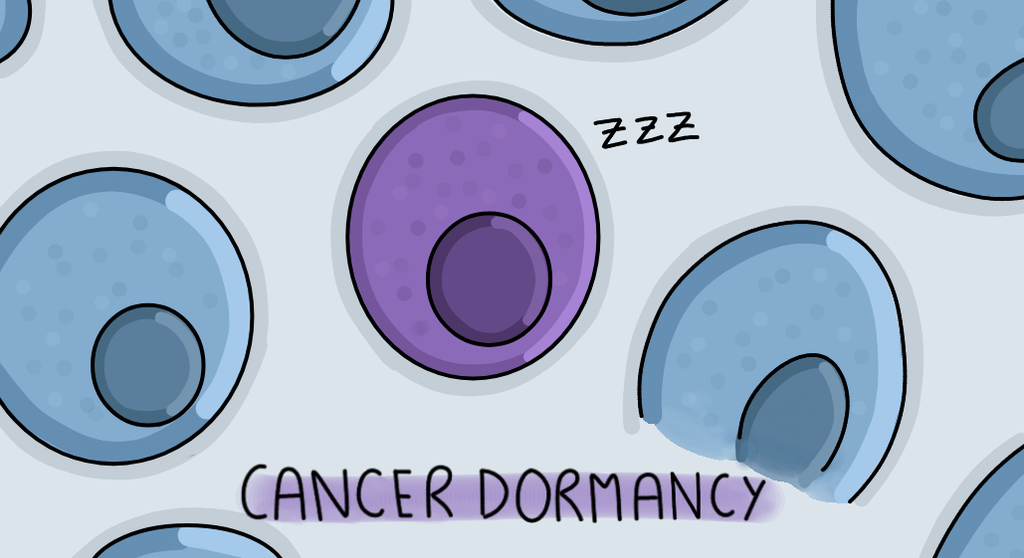
Cancer dormancy is one of those scary concepts in oncology because someone could be told they’re cancer-free, but still end up getting a tumor years or decades later.
That tumor didn’t come out of nowhere, though. It had been lying dormant all that time.
Cancer’s Waiting Game: What Dormancy Means
At the most basic level, cancer dormancy is caused by cancer cells (or small clusters of them) that survive in the body, but don’t form a small tumor that causes noticeable physical signs (an asymptomatic mass).
They enter a state of biological wait. The cells could either be not dividing at all, or dividing and dying at the same rate. And then years (or decades) later, the switch could flip, and then they start dividing again.
This is why breast cancer has recurrence peaks around 5-10 years after surgery, and prostate cancer recurrences 20+ years after a prostatectomy seem complete. The disseminated cells (the single or small groups of cancer cells) were there the entire time.
The 3 Ways Cancer Can Stay Hidden
There are 3 broad mechanisms that researchers categorize cancer dormancy into:
- Cellulardormancy
- Angiogenic dormancy
- Immune-mediated dormancy
- Cellular Dormancy
This is the most straightforward type. Individual cancer cells enter a temporary non-dividing state (quiescence) and stay in the G0 stage of the cell cycle (when the cell stops dividing ). Essentially, the cancer cell is in a hibernation-like state.
This doesn’t mean they’re dead or senescent, just inactive. These cells can usually be reactivated when the right signals are present.
This type has a lot of similarities to normal cell quiescence. The same signalling pathways are involved, too.
- Angiogenic Dormancy
This pathway is when a small group of cancer cells (instead of individual cells) have stunted growth.
This happens because a tumor mass can only grow to around 1-2 mm before it needs to develop its own blood supply to get nutrients. After that, it can’t grow any bigger because there’s not enough room for the cells in the center to get oxygen.
This is why tumors often stop growing, because their growth is limited by their ability to get nutrients. Cells at the edge of the tumor might be able to divide, but there is a lack of blood flow in the center, and the rate of cell death balances out cell division.
Once new blood vessels reach the tumor mass, it can continue to grow.
- Immune-mediated Dormancy
Immune-mediated dormancy is arguably the most interesting pathway. This is the idea that the immune system doesn’t kill all of the cancer cells present. Instead, cancer cells are getting killed (or being held back from dividing) at roughly the same rate as new ones are created.
This theory has 3 phases:
- Elimination
- The immune system recognizes and kills cancer cells
- Equilibrium
- The tumor and immune system are in a kind of stalemate
- Escape
- The tumor finds a way to evade the immune system
Dormancy is essentially the equilibrium phase: the tumor is fighting the immune system, but has persisted for a long time without either side winning.
T cells ( a special kind called CD8+ cytotoxic T cells, in particular- for more information, here is a link: ) are mostly the ones attacking the tumor.
What Makes Dormant Cells Come Back
This is one of the biggest questions in oncology. Understanding it could allow doctors to prevent late recurrences and develop new therapies aimed at reducing their deadly impact.
A few things are known to play a role:
- Changes to the local microenvironment:
- Inflammation or tissue damage can cause growth factors to be released, activating dormant cells. Surgery can also have an ironic twist: due to the tissue damage it causes, it can sometimes wake up dormant micrometastases elsewhere in the body
- Shifts in the angiogenic balance
- If a dormant smaller tumor accumulates mutations, or the local environment changes, it can push the balance from anti-angiogenic (not promoting blood vessel growth) to pro-angiogenic (promoting blood vessel growth) and cause the tumor to grow.
- Decline in immune surveillance
- Aging, stress, immunosuppressive drugs for transplants or other diseases can reduce the immune system’s ability to keep cancer cells in check, allowing them to escape into dormancy.
Why Dormany Matters for Cancer Treatment
Cancer dormancy is one of the reasons that the terms “cancer-free” and “cured” aren’t really interchangeable in oncology, and why patients have to be monitored for years after treatment.
It’s also becoming a huge area of research in itself. While traditional approaches to cancer are all about trying to kill every single cancer cell (like chemotherapy, for example), some researchers are looking for ways to exploit dormancy, making it harder to escape instead.
Essentially, if you can’t find and kill every disseminated tumor cell, can you instead force them into a permanent dormant state?
It’s a very different approach to the problem of cancer, and it’s why there’s a lot of interest in maintenance therapies and immune-checkpoint approaches that seek to improve the immune system over the long term.
A lot of oncologists are starting to see this as a more sustainable approach to keep tumors in check, rather than trying to kill them all at once.
The tricky part with dormancy is that it’s pretty much invisible. Cells that are dormant aren’t forming a visible tumor mass, and it’s not like you can just scan for them or do a regular biopsy and find single cells.
Most research into dormancy has to be done on animals or with very sensitive detection methods to find rare disseminated tumor cells, which is part of the reason that it’s such an under-researched area despite how much oncologists wish they understood it better.
Conclusion
Cancer dormancy is one of the hardest problems in cancer biology. Just because they’re inactive doesn’t mean they aren’t dangerous. By utilizing different methods to evade the immune system and hide, cancer can stay long after it’s thought to be gone.
If you learned anything, make sure to send us a message on our Instagram (@whencellsresist). We love hearing back from our readers!
All original insights and illustrations are our own. This content is not intended as medical advice.
Sources
https://doi.org/10.1158/0008-5472.CAN-14-2406
https://doi.org/10.1158/0008-5472.CAN-15-1370
https://www.frontiersin.org/journals/oncology/articles/10.3389/fonc.2019.00498/full https://onlinelibrary.wiley.com/doi/10.1111/pcmr.12432
https://aob.amegroups.org/article/view/6222/html
https://doi.org/10.3390/cancers11081207