Written by Staff Writer Arsheen Kaur
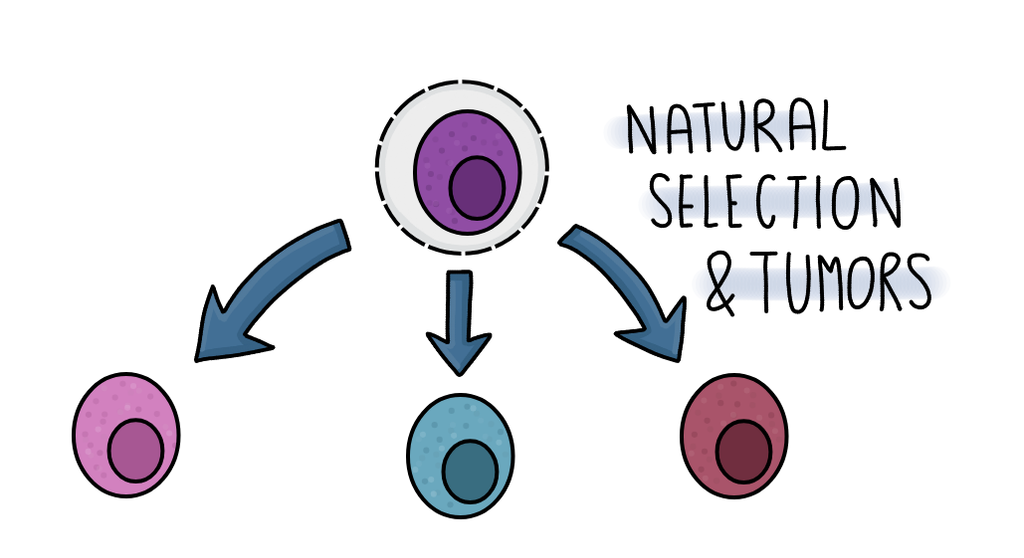
What if cancer treatments could successfully shrink a tumor, only for it to come back months later? How do cancer cells survive treatments that once worked?
The answer lies in evolution.
Tumors can be one of the clearest examples of natural selection. Growth occurs within a single organism over the course of months or years, rather than many generations.
Cancer is often described as a disease of evolution because many of the same
processes that lead to the diversity of species can also lead to the diversity of tumors.
How Tumors Evolve
The idea that tumors are diverse in genetic material dates back to a 1976 paper in Science by Peter Nowell, a decorated cancer researcher.
He proposed that most tumors come from one cell that goes rogue, and that tumor growth and progression come from acquiring differences in the genome or DNA.
Descendants of that cell continue to mutate, allowing for more aggressive strains to emerge.
This is very similar to how Darwin described natural selection. There is:
- Variation: DNA and genetic material in some tumor cells are more likely to change than in normal cells, allowing them to gain new mutations more quickly
- Inheritance: When a tumor cell divides, the daughter cells then generally gain those mutations. Additional genetic changes can occur over multiple generations.
- Fitness: Some mutations can benefit the cell and allow it to thrive or divide faster than other cells, while others don’t. An example is tumor cells having a mutation that allows them to survive low oxygen conditions. Within a population of tumor cells, natural selection can promote cells that acquire beneficial mutations.
The Environments Around Tumors
In natural selection, the environment determines which mutations will be favored. Within a tumor, the environment is the body they’re in. Different subpopulations of tumor cells can emerge and compete with each other for oxygen and nutrients, as well as space to grow.
Some selective pressures that tumor cells are exposed to include:
- Limited oxygen availability
- Limited nutrient availability
- The immune system
- Cancer treatment
How One Tumor Can Contain Many Different Cells
As a result of both the selection pressures and natural selection, tumors often end up becoming incredibly diverse, consisting of different subpopulations of tumor cells. The original malicious cell can acquire even more changes that allow for more advantages.
Modern reviews also note that the process of evolution is actually more complicated than a simple branching tree of original cells and their clones. Clones are groups of cells that are descended from an original cell.
Clonal evolution is much more complex, and selection of traits can occur at different levels on the branching tree (different clones of the original cell) at the same time.
Also, different levels of organization in the body can be affected at the same time (cells, tissues, and organisms as a whole). One of the messier ways this can happen is through tumor cell fusion, where cancer cells can fuse together to become hybrid cells (read more in this post).
Not Everything is Natural Selection
Selection isn’t the only thing controlling evolution in tumors, though. Neutral evolution (where variations in the genetic code have no meaningful effect on the organism) and genetic drift (where the frequency of different types of the same gene change randomly in a population over time without the environment specifically choosing for traits) can also be seen in tumors.
On the other hand, newer research also indicates that selection can also act on reversible cellular state transitions that are caused by the environment as well as permanent genetic mutation. This explains why dormant/ drug-tolerant tumors can re-emerge.
When Treatment Drives Cancer Evolution
When a patient is given chemotherapy, the drug kills most of the sensitive cancerous cells (and some other types of cells), but cells with a resistance trait can survive.
These cells could already have the resistance traits, or randomly mutate them during treatment. They now have access to more resources as they have decreased competition. This effect is what can cause tumors to respond to cancer treatments at first, and then later relapse with a resistant population.
This has led researchers to look into evolution-informed strategies for cancer treatments, like designing drugs that target multiple pathways to reduce the chance of resistance, or manipulating existing dosage to allow for sensitive cells to survive and keep resistant ones in check. These methods ultimately depend on the cancer and type of treatment.
Conclusion
Cancer cells are also affected by the same pressures faced by organisms. Tumors can grow larger and divide faster due to natural selection choosing for genes that suit the environment the best. Understanding these processes can help researchers explain why tumors become so diverse, and why treatments can lose effectiveness over time.
If you learned anything, make sure to send us a message on our Instagram (@whencellsresist). We love hearing back from our readers!
All original insights and illustrations are our own. This content is not intended as medical advice.
Sources
https://pubmed.ncbi.nlm.nih.gov/959840
https://www.nature.com/articles/s41568-024-00734-2
https://www.cell.com/trends/cancer/fulltext/S2405-8033(25)00001-9