All living organisms on Earth have something in common: DNA.
DNA is the genetic material that tells our cells how to make proteins and RNA. These molecules help carry out almost all of the tasks required for life. Even though almost every cell in your body contains the exact same DNA, cells can look and behave very differently. This is because each cell expresses or uses different parts of the DNA, producing proteins that match its specific role.
DNA is located in the nucleus of eukaryotic cells ( cells that have a nucleus and membrane-bound organelles ). Here, DNA is organized into chromosomes, with each human inheriting 23 from their mother and 23 from their father for a total of 46 chromosomes per cell.
DNA isn’t only found in the nucleus. It can also be found in the mitochondria, the energy-producing organelles within cells. Since the mitochondria originated from prokaryotic cells, the DNA is circular and isn’t found in a nucleus but instead free floating in the matrix. You inherit your mitochondrial DNA from your mother, since only egg cells retain their mitochondria during the process of fertilization.
The Structure of DNA: Building Blocks and Organization
The building blocks ( called monomers ) of DNA are nucleotides. Each nucleotide consists of 3 parts:
- A 5-carbon sugar (deoxyribose for DNA)
- a phosphate group
- a nitrogenous base
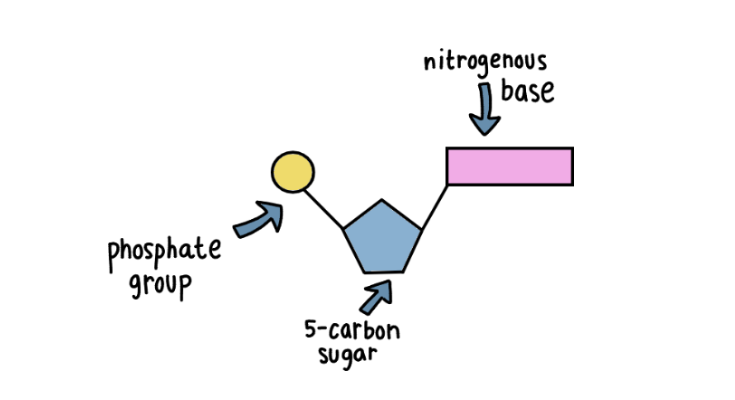
The 4 nitrogenous bases found in DNA are adenine (A), thymine (T), guanine (G), and cytosine (C).
Bases follow the complementary base pairing rules. Adenine binds to thymine with 2 hydrogen bonds, and cytosine binds to guanine with 3 hydrogen bonds. This precise pairing allows DNA to replicate itself accurately, making sure that genetic information is reliably passed on when cells divide.
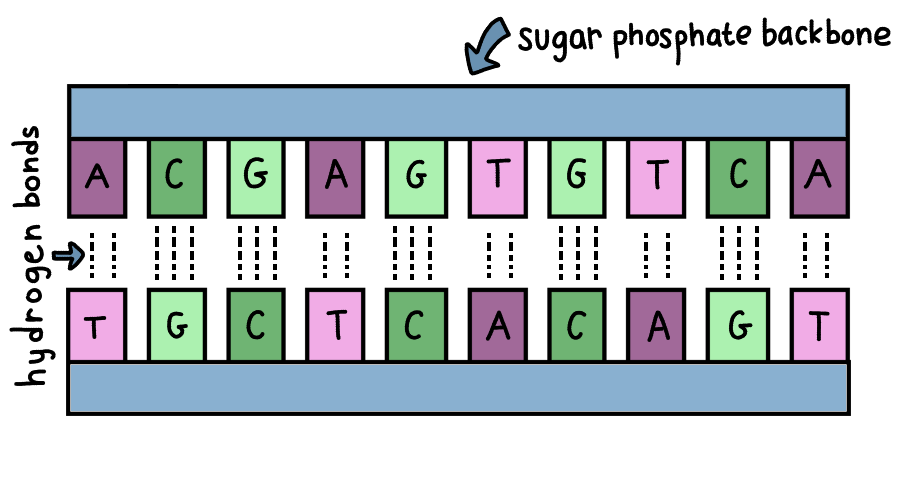
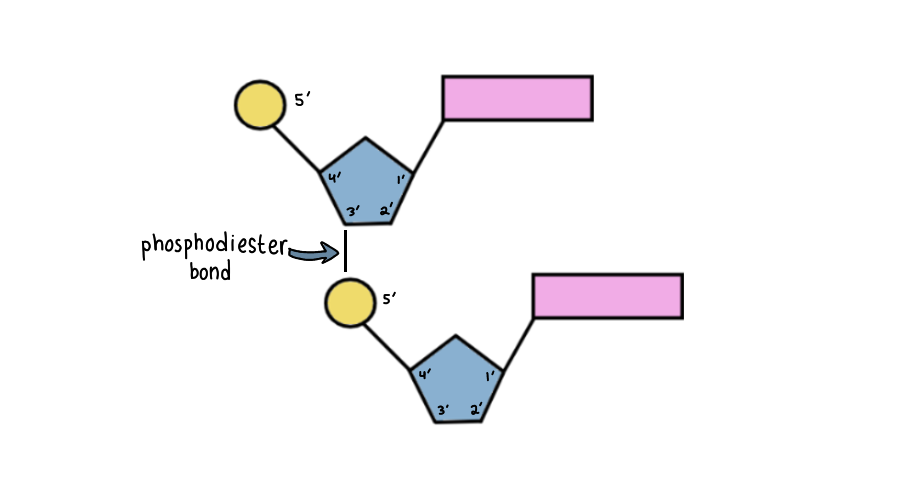
Nucleotides are linked together through phosphodiester covalent bonds between the 5’ carbon of one sugar and the 3’ carbon of the next, forming a sugar phosphate backbone. This backbone supports the two strands of DNA, which twist together into a double helix shape.
DNA & RNA: What’s the Difference?
DNA isn’t the only genetic material in our bodies, however. There is another type called RNA. It has important functions in our cells, like translating our DNA into proteins or bringing amino acids to help make proteins. The 3 main types of RNA, used for protein synthesis, are mRNA, tRNA, and rRNA. These will be explained in detail in another post. There are other types of RNA, though, used for different purposes, like microRNA or ribozymes.
RNA differs from DNA in a few key ways. It is usually single-stranded rather than double-stranded, contains the sugar ribose instead of deoxyribose, and uses the base uracil (U) instead of thymine.
The specific part of the DNA that codes for a protein is called a gene.
Not all of the DNA codes for proteins, though. Parts of the DNA don’t code for proteins, called noncoding DNA. These parts make up most of the DNA and assist with jobs like transcription. They can also code for RNA.
DNA Mutations and Their Link to Cancer
DNA holds the instructions that make each one of us unique. It is surprisingly uniform across a wide variety of life here on Earth, with almost the same structure and rules used by most cells. By understanding how DNA is structured and its role alongside RNA, we can understand the beginnings of the processes that keep us alive.
DNA is important for cancer because it contains the code for many different things like when cells should perform apoptosis, and genes that regulate how fast a cell can replicate. Damage to the DNA can cause these genes to become changed, or mutated and consequences like the cells never dying or replicating/ growing too fast.
In the next post, we’ll be learning about what proteins are and why they are so important to how cancer works.
If you learned anything, make sure to send us a message on our Instagram (@whencellsresist). We love hearing back from our readers!
All original insights and illustrations are my own. This content is not intended as medical advice.
Drawings are simplified for illustrative purposes and may not be exact representations of the subjects
Sources
https://www.genome.gov/genetics-glossary/Deoxyribonucleic-Acid-DNA
https://medlineplus.gov/genetics/understanding/basics/dna
https://my.clevelandclinic.org/health/body/dna
https://www.youtube.com/watch?v=4b5AkUT30og&t=5s
https://www.khanacademy.org/test-prep/mcat/biomolecules/dna/a/dna-structure-and-function
https://www.genome.gov/about-genomics/fact-sheets/Deoxyribonucleic-Acid-Fact-Sheet
https://byjus.com/biology/difference-between-dna-and-rna
https://news.cuanschutz.edu/dbmi/what-is-junk-dna
https://www.genome.gov/genetics-glossary/Transfer-RNA-tRNA
https://www.genome.gov/genetics-glossary/Transfer-RNA-tRNA
https://byjus.com/biology/prokaryotic-and-eukaryotic-cells
https://www.sciencedirect.com/topics/biochemistry-genetics-and-molecular-biology/nucleoid