Written by Staff Writer Arsheen Kaur
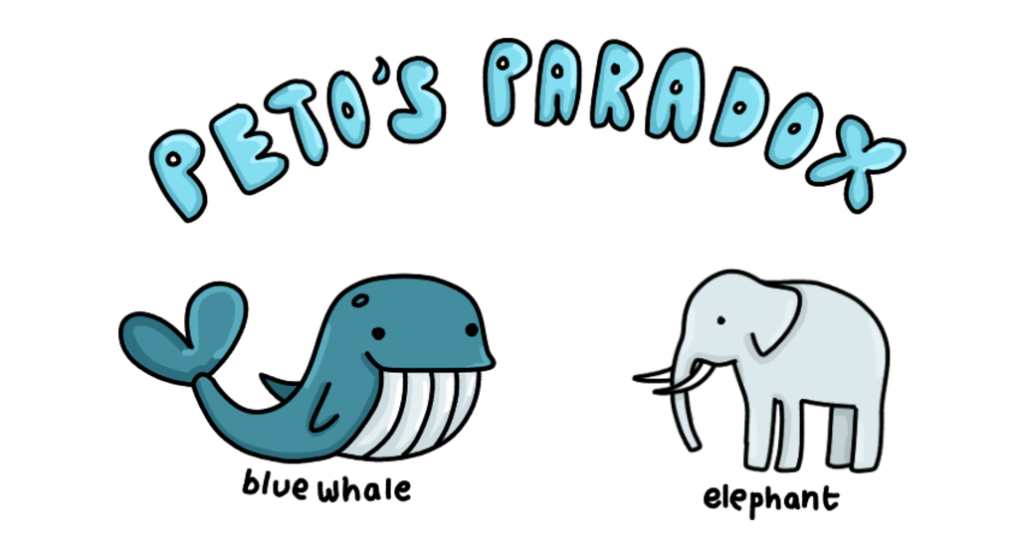
Which one has a higher risk of cancer: blue whales or mice?
If cancer were simply a numbers game, blue whales should be absolute giants when it comes to tumors. With around a thousand times more cells than a human, and a lifespan of 80-90 years, there should be a ton of opportunities for things to go wrong.
Whenever cells divide, there’s a chance that a mistake will occur in their DNA. The more cells you have of a given type, the more chances there are for errors to happen as they replicate. On top of that, the more frequently cells divide, the more chances there are for those same errors to occur.
If we related the facts, one would assume that whales would have a significantly higher chance of getting cancer compared to humans. Instead, they aren’t much more likely to develop malignant growths at all. The same can be said for elephants, despite having around a hundred times more cells than people.
So really, mice are actually more likely to develop cancer than blue whales. But why?
What is Peto’s Paradox?
These inconsistencies in cancer rates compared to cell numbers are known as Peto’s paradox, named after Richard Peto, who first observed and noted the phenomenon in the 1970’s through statistical reasoning.
In order to get an idea of why cell numbers are supposed to relate to cancer rates so strongly, it’s useful to think about how cancer develops in the first place. In short, it happens when a cell gains enough mutations that it goes on a rampage, dividing uncontrollably and refusing to die off before it’s supposed to.
Anytime a cell divides, errors in the DNA coding can occur. The bigger the organism and the longer its lifespan, the more total cell divisions that need to happen in order for it to grow and maintain its tissues and organs. A small animal with a short lifespan like a mouse has far fewer cells to worry about, with each of those cells only dividing every few years or so. That means fewer potential mutations and a lower risk of each mutation causing a harmful result.
When it comes to large animals, however, the opposite is true. In fact, when looking at different species within the same group, this trend holds. Taller humans have a slightly higher cancer risk than their shorter counterparts. Large dog breeds also have higher rates of malignancies than small ones.
So, shouldn’t it make sense that larger animals have higher cancer risks than smaller ones?
How Do Large Animals Defy Cancer?
As soon as you begin comparing different species, the pattern stops holding. Large animals like whales and elephants should have an incredibly high cancer risk due to both their size and lifespan, but don’t seem to have rates any higher than the average human.
The simplest explanation for Peto’s paradox is that large, long-lived animals have better defenses against malignancies than smaller creatures. Evolution cares about promoting traits that improve an organism’s ability to survive and reproduce, so while natural selection might favor cancer defenses for medium-sized animals like humans, larger animals would need to have more measures in order to stay healthy.
This is because any random mutation that decreases cancer risk would prevent the animal from dying prematurely, giving it more of an opportunity to pass on its genes.
Over the long term, the accumulation of the advantages can lead to those mutations becoming common in a given population simply because they help individuals survive longer.
How Elephants Resist Cancer
When it comes to elephants, those built-in safety measures are pretty well-understood at a genetic level. In addition to having the same two TP53 genes as humans, who are often referred to as the “guardian of the genome,” elephants have another 18 copies of the same set of genetic instructions. That particular segment of DNA encodes a protein that can detect errors and cause the affected cell to go through apoptosis, or programmed cell death, preventing it from dividing out of control later on.
Researchers have found that elephant cells respond to DNA
damage far more strongly than people, essentially hitting the self-destruct button with much greater frequency. It stands to reason that having extra copies of a helpful gene would grant additional protection against cancer by providing more safeguards.
What About Whales?
It’s still unclear exactly how whales are able to avoid getting cancer at such a much higher rate than one would expect, since genome-wide association studies have so far only uncovered a few likely suspects. Scientists suspect that some of them may involve genes that repair damaged DNA, or help prevent tumor growth in other ways, but the exact mechanism remains unclear. Researchers have reason to believe that different large animals might have unique genetic adaptations that help them, rather than a single defining trait that all of them share.
Could Animals Help Us Fight Cancer?
Peto’s paradox is much more than just an oddity, though. When it comes to figuring out how to combat cancer, any insight into alternative methods of suppressing tumors could prove incredibly valuable down the line. Researchers have even begun experimenting with some of the genetic modifications that elephants utilize, as artificially inducing similar changes in human cells seemed to cause them to go through apoptosis more readily. The discovery could lead to a large number of new cancer treatments that would be incredibly useful in the long run.
Furthermore, the concept behind Peto’s paradox is a great example of the way in which science works. Researchers notice patterns that deviate from what they expect, and seek out an explanation as to why they occur. If we didn’t take the time to consider why seemingly strange things happen, we wouldn’t be able to understand how the world works nearly as well.
Conclusion
By questioning why the observed data doesn’t match up with the expectations, scientists are able to find new information that can lead to further advancements in the future. In the end, an anomaly that seemed strange enough to warrant discussion nearly four decades after its initial discovery is a great sign for scientific progress.
Either way, Peto’s paradox is a perfect example of how biology can often be counter-intuitive.
If you learned anything, make sure to send us a message on our Instagram (@whencellsresist). We love hearing back from our readers!
All original insights and illustrations are our own. This content is not intended as medical advice.
Want to Explore More?
https://www.youtube.com/watch?v=1AElONvi9WQ
https://www.the-scientist.com/peto-s-paradox-how-gigantic-species-evolved-to-beat-cancer-72725
https://www.nature.com/articles/s41586-021-04224-5
Sources
https://pmc.ncbi.nlm.nih.gov/articles/PMC5061548
https://www.biorxiv.org/content/10.1101/187922v2.full.pdf