A Deep-dive into Syn-Bio Oncology ft. Spliced.

Introduction
What if a future cure for cancer wasn’t from chemotherapy, immunotherapies, or surgery but something normally thought of as “bad”? Bacteria (yes, really) could offer us a solution to normally hard-to-reach tumors that our current attempts haven’t been able to crack, through a process most people associate with computers and machines. Using programming languages, scientists have been able to make bacteria detect and fight cancer using their naturally existing machinery.
In this blog post, we’ll cover the fascinating field behind this discovery, synthetic biology, why bacteria are actually a smart choice for the fight against cancer, how scientists code bacteria, discoveries scientists have made to use bacteria for cancer, and the challenges behind this field.
What is Synthetic Biology?
Synthetic biology today has developed far more than what was expected from it ten years ago. Cells are being re-engineered to solve problems like sustainability, targeted therapy, customizable medicine, and so much more.
The field itself can be seen as a transition from viewing nature as a finished piece of art to viewing nature as a living toolbox with genes as the language of instructions. Instead of analyzing the instruction manual as it stands, scientists are now learning how to read the code written by DNA as if it were computer programming and using the knowledge gained to create new realities.
Picture microbes that can eliminate microplastics in the ocean without making any noise, plants that can glow at night so as to replace street lamps, or even cells that have been specially designed to find and correct diseases in the human body.
Using advancing genetic modification technologies, the capabilities of science and modern biology in altering genes and creating new ones have expanded the horizons of possibility.
Why Code Bacteria?
So, why do we choose to code bacteria instead of human or animal cells instead? This is due to the fact that bacteria are much simpler and duplicate much faster, while requiring fewer resources to stay alive.
Bacteria come from the Bacteria domain. The other 2 domains of life are Archaea and Eukarya. Their DNA is stored in the form of a small circular plasmid, which can be exchanged with other bacteria in a process called horizontal gene transfer. Think of the plasmid like the chromosomes in a eukaryotic cell. Bacteria have 1 main plasmid and other smaller plasmids from other bacteria. They contain a plasma membrane, cell wall, a capsule that keeps the cell from drying out, and appendages that allow them to stick onto surfaces.
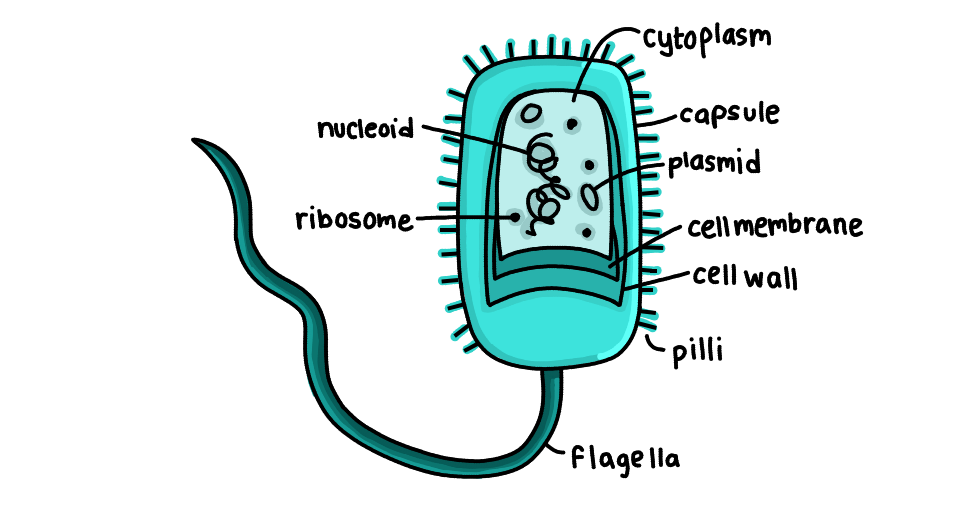
Bacteria are much more simple that eukaryotic cells. They have less DNA, due to a higher selectivity for useful genes. Eukaryotic cells, on the other hand, can retain DNA that doesn’t provide value for a long time. Inserting new DNA is also much easier with bacteria. They are already naturally accustomed to swapping DNA with other bacteria, whereas eukaryotic cells have mechanisms to prevent interference with their DNA.
They duplicate much faster too, dividing every 20 minutes. Eukaryotic cells usually take 24 hours to divide. This is useful for making large batches for testing. Bacteria also require much less to survive.
Why are we specifically trying to use bacteria to fight cancer? Well, bacteria naturally grow inside of tumor cells. The environment around tumor cells is usually devoid of immune cells, allowing the bacteria to divide easily without resistance. We can insert genes that allow bacteria to detect or fight cancer, allowing us to reach places in the tumor that are traditionally very hard to access.
How to Code Bacteria
Here, we’ll be covering the basics of how to program bacteria. Coding bacteria requires using plasmids and inserting them into a bacterium. We can insert DNA into the plasmid, which can come from other organisms or be synthesized by scientists via DNA synthesizer machines. A DNA synthesizer lets scientists make a custom DNA sequence from scratch with nucleotides.
Plasmids can be obtained from bacteria by using methods that open cells and separate the DNA from other components. Scientists can either use naturally occurring plasmids or plasmids engineered for research purposes. These plasmids are cut open by enzymes called restriction enzymes. These enzymes are derived from bacteria, and they cut open the plasmid, leaving sticky ends that have overhangs of DNA. These short overhangs form temporary hydrogen bonds between complementary sequences of bases on other DNA sections cut with the same restriction enzyme.
The newly opened plasmid and the desired DNA (cut with the same restriction enzyme) are mixed together. A small number of sticky ends from the DNA pair up together temporarily with the sticky ends of the plasmid. After this, DNA ligase stitches the two pieces of DNA together with a strong covalent bond to make a new recombinant plasmid.
After the DNA has been combined with the plasmid, the bacteria and plasmids are both placed into a solution containing lots of calcium ions, which neutralize the negativity of the plasmid DNA and bacterial cell membrane. The combination of the calcium ions and a procedure of cooling the mixture and then giving it a heat shock (which makes temporary openings in the membrane) makes it more likely that the plasmid passes through the cell membrane into the bacteria. This process is called transformation. The process isn’t very efficient since only a small amount passes through.
How do scientists know that the plasmid is inside the bacteria? They usually insert another piece of DNA, like an antibiotic resistance gene, that lets them test the bacteria afterward. This piece of DNA is called a selectable marker. A popular way to test DNA involves inserting a reporter gene ( DNA attached to the promoter of a gene that only works when that gene is activated ) that makes GFP, or green fluorescent protein, which glows bright green under UV light.
How Coded Bacteria Fight Cancer
Recent developments showcase a unique ability to design and optimize gene networks with extraordinary accuracy. Scientists have developed living bacterial systems that can deliver drugs directly to targeted environments, thus producing them in situ and avoiding any adverse effects caused by their administration in other parts of the body.
At the same time, progress in research on cell-free synthetic systems and metabolic engineering allows one to produce valuable medicines, materials, and bio-plastics without the need for living organisms. In environmental biotechnology, scientists are developing circuits in plants and microbes to detect and remediate industrial pollutants, and recent developments in synthetic chloroplasts seek to increase the rate of carbon fixation in plants significantly.
In cancer research, scientists at the University of Waterloo earlier this year made bacteria that could engulf tumors from the inside. Tumors usually have an oxygen-poor core, and the scientists took advantage of this by using a soil bacterium that thrives in low-oxygen environments. They allowed it to grow inside the tumor, depleting nutrients from the tumor and eating it from the inside out. However, they ran into a problem.
The bacteria would start dying if they reached the oxygen-rich edges of the tumor mass. The scientists fixed this problem by using quorum sensing. Quorum sensing is a process where bacteria send chemical signals to each other to detect how dense their population is.
As the bacteria multiplied and their density grew inside the tumor, they released chemical signals. Once the population hit a specific density threshold, it triggered the activation of an oxygen resistance gene that the scientists placed.
Challenges
There are still a lot of challenges with programming bacteria at the moment. The field is still young, which means that it’s constantly evolving. Some challenges include:
Not knowing the roles of certain genes and their widespread effects
We still don’t know what a large number of genes in bacteria do, and what their effect is on other genes once removed or modified. This can lead to unintended results and tedious trial-and-error testing to ensure experiments run smoothly.
Constructing genetic circuits
Constructing and inserting genetic circuits can be very tedious and labor-intensive. With a very small number of bacteria taking up modified plasmids, it can often take many attempts before a bacterium successfully expresses the desired result.
Testing bacteria for desired result
Testing how artificially engineered bacteria perform can take some time. Lots of different factors like growth and division rates, variability between different cells, and genetic circuit instability and unintended results can make trials last longer and stall innovation.
Ethical concerns
Bacteria could be synthesized for malicious purposes like producing toxic compounds or causing harm to patients. Labs might also unintentionally release toxic bacteria from experiments due to lax lab procedures.
Difficulty automating process
Swapping or adding new genetic material doesn’t always act predictably. Tuning genetic circuits still requires someone to tweak them to be optimized. Full automation and standardization are difficult at the moment.
Despite all of these challenges, the field has grown immensely from where it once started. In the future, we might be able to solve these challenges, leading to more innovative biologic solutions to the world’s problems.
Recent Innovations In Synth-Bio
Recent developments showcase a unique ability to design and optimize gene networks with extraordinary accuracy. Scientists have developed living bacterial systems that can deliver drugs directly to targeted environments, thus producing them in situ and avoiding any adverse effects caused by their administration in other parts of the body.
At the same time, progress in research on cell-free synthetic systems and metabolic engineering allows one to produce valuable medicines, materials, and bio-plastics without the need for living organisms. In environmental biotechnology, scientists are developing circuits in plants and microbes to detect and remediate industrial pollutants, and recent developments in synthetic chloroplasts seek to increase the rate of carbon fixation in plants significantly.
Conclusion
Synthetic biology is creating new ways to use bacteria as tools to fight cancer and other problems. Together with protein design platforms based on AI algorithms, which are able to generate novel enzymes, synthetic biology evolves from being a modification of existing forms of life into a tool for addressing humanity’s complex problems.
By programming bacteria with specific instructions, we can make them work in ways other drugs normally can’t. While there are still challenges in the field, continued research could make engineered bacteria a viable option for patients soon.
If you learned anything, make sure to send us a message on our Instagram (@whencellsresist). We love hearing back from our readers!
Acknowledgements
This post was written in collaboration with the team at Spliced., a synthetic biology blog. If you’re interested in explanations about how we can code our biology to solve modern problems, they are the perfect place to check out.
Thanks for such an awesome and interesting collaboration!
Support the Spliced. Syn- Bio Blog Team:
Sources:
https://www.creative-biolabs.com/blog/index.php/three-major-challenges-in-synthetic-biology/
https://www.ted.com/talks/tal_danino_programming_bacteria_to_detect_cancer_and_maybe_treat_it
https://www.youtube.com/watch?v=2DgVdxAZFsI
https://www.lesswrong.com/posts/wpRP44NT6kHaKNdnn/why-are-bacteria-so-simple
https://uwaterloo.ca/news/media/beating-cancer-eating-cancer