Written by Staff Writer Arsheen Kaur
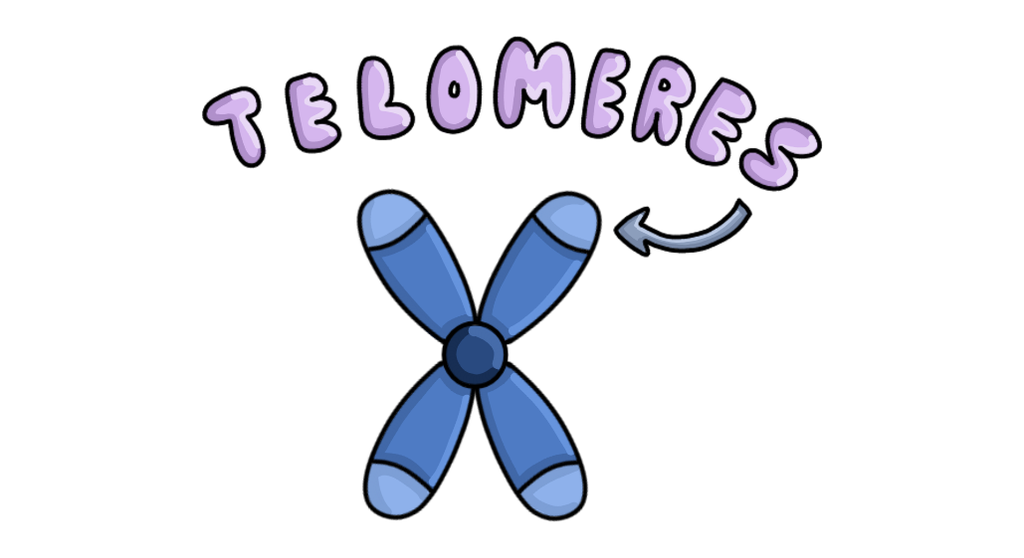
Every time a cell in your body divides, something weird happens: its chromosomes get shorter. This happens because the enzyme that controls DNA replication, DNA polymerase, can’t copy the end of one of the strands of DNA.
If this happens enough times, it can make the cell unable to divide any longer, signalling cell death or causing genetic damage.
This phenomenon is called the Hayflick limit, which is like an expiration date for your cells.
So why don’t our cells die after a mere couple dozen cell divisions?
The answer lies in an enzyme called telomerase, which acts like a balancing force between cell division and cellular aging.
The Problem of DNA Copying
Imagine your DNA as a long shoelace. The enzyme, DNA polymerase, that copies DNA is something that reads the shoelace and makes an identical copy.
There’s one problem: it can’t reach the ends of the shoelace to copy them. Every part of the DNA is important, even the seemingly “useless” ones. If the enzyme couldn’t reach these parts, you’d have mutated proteins in every cell in your body every time they divided, which is obviously not the case.
Your chromosomes have a solution to this problem: telomeres. These sequences of non-coding DNA are like the plastic tips on the ends of shoelaces. They don’t contain any useful information, and they’re there to serve as a buffer that can not be copied.
So when your cells divide, your chromosomes get shorter by a predictable amount, until they’re almost exhausted. Then, your cells age and stop dividing (senesce) or commit suicide (apoptosis).
A Way Around the Clock
Most healthy cells in your body don’t have telomerase. Telomerase is responsible for adding more DNA to the ends of your telomeres. This addition is essential for rebuilding your telomeres, which can be used in a controlled way to lengthen them back to their full length, resetting your cellular clock.
However, your body only uses telomerase in certain cells, most specifically, stem cells. These stem cells then divide to make up most of the cells in your body. The enzyme is not used in most mature cells in your body, and it’s turned off or used up in most cell divisions.
Telomerase is important because it’s a way around the telomere limit. Cells that have telomerase can keep dividing indefinitely because they can rebuild their telomeres.
Why Telomeres and Cancer Cells Matter
Cancer cells are more likely to acquire the ability to express telomerase. It lets them do what stem cells do: become immortal by letting their telomeres rebuild with every division. This lets them continue dividing and growing, ignoring the body’s natural control mechanisms and the Hayflick limit.
This is why telomerase is such a good target for cancer therapies, as it’s a huge part of what allows a cell to survive past the Hayflick limit.
Another pathway called ALT also acts in a way to maintain telomere length without telomerase. But since approximately 85-90% of human tumors have active telomerase, scientists have instead been looking at this enzyme for targeting cancer cells individually.
A promising telomerase-inhibiting drug called imetelstat is currently in trials for a number of blood cancers; however, there’s been difficulty in getting it to be specific enough to target only cancer cells while not affecting healthy stem cells. Hopefully in the future, we will develop more innovative therapies that target this enzyme effectively, putting a stop to the immortal nature of cancer cells.
Conclusion
Telomerase acts as a cellular fountain of youth, restoring the protective telomeres at the ends of chromosomes. While healthy stem cells use this process to sustain normal tissue growth, cancer cells exploit it for immortality.
Telomerase is actually one of the clearest examples of how cancer works. It improvises with existing biological mechanisms, manipulating enzymes and pathways for its own survival.
If you learned anything, make sure to send us a message on our Instagram (@whencellsresist). We love hearing back from our readers!
All original insights and illustrations are our own. This content is not intended as medical advice.
Want to Explore More?
https://www.youtube.com/watch?v=5mHw0vGcYvA
https://pdb101.rcsb.org/motm/227
https://www.youtube.com/watch?v=CrTvmxiJy20
https://www.youtube.com/watch?v=CrTvmxiJy20
https://pmc.ncbi.nlm.nih.gov/articles/PMC3583695
Sources:
Armstrong, C.A. & Tomita, K. (2017). “Fundamental mechanisms of telomerase action in yeasts and mammals: understanding telomeres and telomerase in cancer cells.” Open Biology. https://www.ncbi.nlm.nih.gov/pmc/articles/PMC5376709/
Ramlee, M.K. et al. (2016). “Reactivation of telomerase in cancer.” Cellular and Molecular Life Sciences. https://link.springer.com/article/10.1007/s00018-016-2146-9
“The role of telomere and telomerase in cancer and novel therapeutic target: narrative review.” https://www.ncbi.nlm.nih.gov/pmc/articles/PMC11947687/
“Modulation of Telomerase Activity in Cancer Cells by Dietary Compounds: A Review.” https://www.ncbi.nlm.nih.gov/pmc/articles/PMC5855700/
“Telomeres and telomerase in oncogenesis (Review).” Oncology Letters (2020). https://www.spandidos-publications.com/10.3892/ol.2020.11659