Written by Staff Writer Arsheen Kaur
When it comes to cell biology, cancer really has a way of breaking rules.
Normal cells follow a specific code of conduct in order to sustain order, sticking close to home, replicating only when told to, and committing suicide (apoptosis) when injured or away from their niche.
Loss of contact with neighboring tissues or the extracellular matrix triggers a specific cell death program called anoikis ( “homelessness” in Greek) in order to prevent rogue cells from going on a journey through the body.
Cancer cells, on the other hand, are completely uninterested in these rules. They replicate even when conditions aren’t ideal and don’t commit apoptosis when away from their niche or injured.
Once a tumor starts to grow out of control, it becomes crowded, oxygen-deprived, and starved for nutrients. This is because the tumor’s own success in replicating has overwhelmed its blood supply, creating a hostile and oxygen-poor neighborhood within a solid tumor.
In order to survive, cancerous cells perform one of the most ridiculous feats in biology: entosis (aka cellular cannibalism).
The Mechanism: Infiltration vs. Ingestion
Let’s talk about entosis. To understand entosis, we need to understand its difference from the similar mechanism of phagocytosis.
Phagocytosis is like a cellular garbage truck that finds dead cells or large particles floating (this is for white blood cells) around in solution and eats them whole by surrounding them. The white blood cell extends its own membrane outwards to encircle the debris and pulls it in.
Entosis, on the other hand, is like two slightly crazed neighbors during a mass power outage during a blizzard. Neither has enough fuel to keep their heating systems running, and one decides to go to the other’s apartment door, break it down, and force their way in for fuel (we of course don’t recommend this in the event of an emergency).
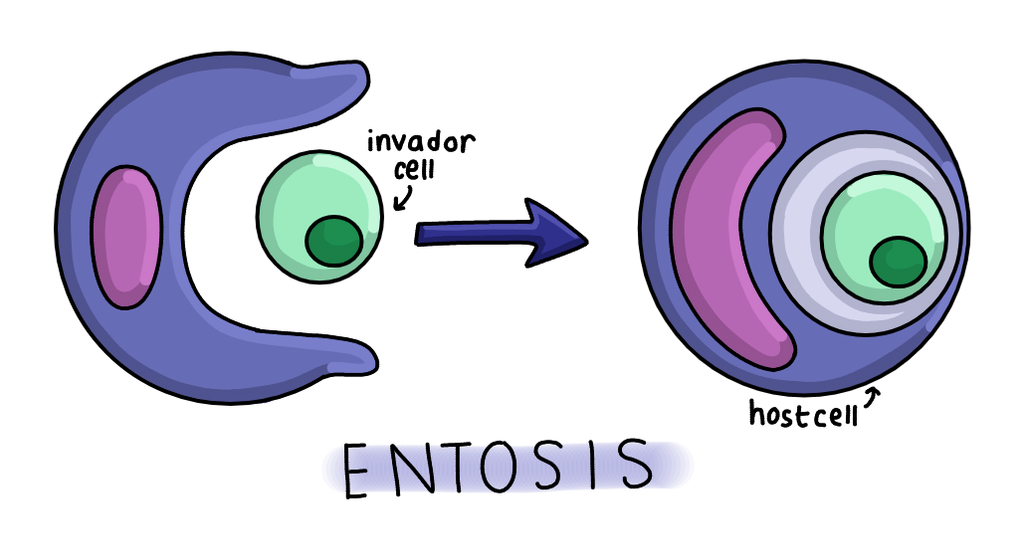
In the case of cells, this means one interloper cell invading into another cell for its resources (like energy or cellular machinery).
Instead of the host cell swallowing the cell, the invader actively squeezes its way in. It uses its own actin-myosin machinery (the same proteins that allow muscles to contract) to generate force and squeeze through a host cell’s membrane, kind of like pushing through a gap in a fence.
Once inside, the invading cell becomes trapped within a compartment called a vacuole alongside the host cell’s nucleus, which takes on a crescent shape due to being forced against the vacuole membrane. This physical stress can also deform the cell’s cytoskeleton and contribute to problems with chromosomal separation later on.
From here, one of three things can happen:
- Digestion: Most commonly, the host cell destroys the trapped cell and dissolves its contents by releasing lysosomal enzymes into the vacuole. The lysosomes act like the cell’s digestive system, breaking down the invading cell. During nutrient starvation, this can provide the host with some nutrients.
- Escape: Sometimes the trapped cell can stay alive. When stressful conditions improve, it can escape from the host cell by squeezing out the way it entered once the coast is clear.
- Cell division: The trapped cell, in some cases, can undergo mitosis while still inside the host. This makes what researchers call a “cell-in-cell” structure, where one cell contains 2 or more living daughter cells.
Cellular Cannibalism: a Double Edged Sword
Entosis can either fight cancer or help it grow depending on the situation.
On the protective side, it can protect the body by eliminating damaged or detached cells before they can spread. The host cell engulfs and digests these cells, helping remove potentially dangerous cells.
Entosis can also help cancer survive. When nutrients are scarce, stronger cancerous cells can digest weaker neighboring cells and use them as a source of nutrients. Entosis can help cancer cells survive conditions that might otherwise kill them.
This phenomenon also creates another problem: chromosomal instability. When a cell trapped inside another cell tries to perform mitosis, the physical deformation can interfere with anaphase, when chromosomes separate. The chromosomes can divide unevenly, leaving daughter cells with the wrong number of chromosomes (aneuploidy).
This genetic instability can make tumors more aggressive and potentially more resistant to cancer treatments.
Entosis is a double-edged sword. It can remove dangerous cells in some situations and help them in others.
If you learned anything, make sure to send us a message on our Instagram (@whencellsresist). We love hearing back from our readers!
Sources:
Overholtzer et al. — Cell (2007)
Krajcovic et al. — Nature Cell Biology (2011)
Mechanisms and Consequences of Entosis — PubMed
Cell-in-Cell Phenomenon and Its Relationship With Tumor Microenvironment — PMC; Entosis: From Cell Biology to Clinical Cancer Pathology — PMC
Cell-in-Cell Structure in Cancer: Evading Strategies from Anti-Cancer Therapies — PMC
One response to “When Cells Eat Cells: The Strange Biology of Entosis”
[…] read the next post here […]